Showing posts with label branding. Show all posts

Saturday, April 2, 2016

TD - the Right Way to Play

People don't usually love their bank. Usually they don't even like it. But TD defies gravity on this one.  I've written about this before - TD is a loved bank in a very unloved category. What I didn't write was that I had been a customer of a major bank, grown very unhappy with its institutional feel and lack of flexibility. I disliked the personal interactions- because, at the time, it seemed as if the employees were counting seconds to coffee breaks. So, I switched to Canada's most loved bank. I've been happy ever since. And, here's another personal story why TD constantly knocks it out of the park.

Every year, students on university campuses across the country organize a Right to Play fundraiser. For those unfamiliar with the charity, Right to Play is an organization that helps disadvantaged kids in disadvantaged regions play sport.  The concept is that these kids learn teamwork, leadership, and receive all the healthy mind and body benefits that accrue with team sport. Right to Play helps kids in my city and around the world.
Right to play organizers                                  Tastiness of a pie
The event that the students organized at my school works like this.  The student volunteers get some profs, faculty members, and student leaders to donate 15 minutes to be pied in the face. A "pie-er" is then selected based on the highest donation targeted towards the volunteer pie-ee.  Its a lot of fun, especially if you like whipped cream. Embodied in this approach is a fun competition amongst the volunteers to have the highest donation level.  And this is where TD fits in.

I decided to ask for a few donations from some of the business that I frequent.  After explaining I the charity, and the friendly competition that I was in,  Right to play generosity of employees of different businesses.  But when I visited my local TD branch, the bank manager called me into this office.   He said, "Bob, we love to help out good causes... we love to help local causes.  And, we love you as a client.  Let's see what we can do. I'll see if I can shake the tree..."

I walked out with a $500 check made out to Right to Play and saw first hand the excitement of the Right to Play organizers. (This size of this donation is in another stratosphere). In the back of my mind, I couldn't help think of the contrast of my old bank. This is not just about the donation, but from the warmth and love from which it was given. Thanks TD!

Good luck Right to Play. And to the organizers of the fundraiser- well done!

And, to my pie-ers.... I'll get you back ;-)


Sunday, November 23, 2014

Toronto trounces brand Montreal


by Genevieve McCallum

As someone who grew up in Toronto and is now at university in Montreal, I often get asked which city I like better. I’m a Torontonian through and through, with no doubt as to which side of the Montreal/Toronto rivalry I fall on. But now as a student of branding, I started thinking which city has a stronger brand- Montreal or Toronto?

To do a quick comparison on the brand equity of Toronto versus Montreal, I did a couple Google searches. The idea here is that the more returns that come back, the higher the awareness of each city.   Google returns about 450,000,000 results from a search on “Toronto” vs. 33,000,0000 results for “Montreal.”  That’s a route for Toronto awareness.

So what might be driving Toronto’s big win?  Well, here are a few thoughts.  First, according to the organizations that track this kind of stuff, Toronto has more than double the number of head offices that Montreal has (175 vs 81).  In other words, the greater number of head offices provides Toronto with more high paying jobs, more business visits to the city, driving more hotel visits, more theaters, more restaurants etc.  Second, Toronto has 3 major professional sports teams (the Toronto Maple Leafs, the Toronto Jays, and the Toronto Rapters) compared to Montreal’s lonely Canadiens. Translation: Toronto still gets its scores reported more often in more seasons, on more media than Montreal.  Finally, Toronto wins on cityscape. The world famous CN tower (for the longest time the tallest free standing structure in the world) simply trumps the Olympic Stadium located away from the downtown core.

I remember my dad telling me that forty years ago, around the time that the ’67 Olympics were held, Montreal was Canada’s leading city. I’ve just argued that  this seems to no longer be the case.  Perhaps I’m biased because of where I’m from, so I’m curious: to all the born and bred Montrealers out there, how would you argue in Montreal’s defense? 

Tuesday, October 29, 2013

"UN Rita" & our awesome, diverse world

“The things you do for yourself are gone when you are gone, but the things you do for others remain as your legacy.” ― Kalu Ndukwe Kalu

* * *

 Last week, one of my dearest friends passed away.  Her name was Rita O'Sullivan.  She was in her 90s.

Rita was always a special person to me.  She was a close family friend who gave me my first summer job when I was 16.  I sold books in her bookstore. She taught me how to play Scrabble. She always won. Rita also gave me my first sip of cognac. I'll never forget that day.  I was 11 years old and it was New Year's Eve. To quote Rita, "we'll separate the men from the boys tonight."  I toasted with the men (my dad included)  and my throat burned like hell from a drop of the stuff.  I learned to respect hard alcohol the hard way.

There is something that Rita had in her heart that separated her from almost everybody else I ever met and is why her legacy is so much more than jobs, board games, and a fun times. Rita loved people- all people- no matter skin color, heritage, faith, abilities, or origins. She was the best teacher of humanity, respect, and human love because of the way she lived. Anyone who followed Rita's approach learned from her just how amazing each person really is. This is a key part of her legacy that lives on...

Every New Year's Eve, my family would go to Rita's legendary New Year's Eve parties. There, Rita would have a full complement of  United Nations to celebrate with. There were Catholics, Evangelicals and Jews, Hindus, Sikhs and Muslims. There were Vietnamese, Sinhales, and Irish; Indians, Latinos, Ukrainians and Poles. Her guests had names like "James", "Nang", "Dabadaba", and  those names that need a deep click in the throat to pronounce. Rita, who herself was a devout Catholic, lived diversity. Her mantra was "God made all people to love one another." Gandhi might not have made his famous statement, "I love your Christ. [But I don't like Christians because]so many of you Christians are so unlike your Christ" had he had a chance to hang around with Rita.

* * *

So what does all this have to do with brands and marketing? When you think about it, people from different geographies develop expertises. Companies and brands, then have the opportunity to leverage geographies of origin when marketing their products (e.g. think how Chanel is linked to Paris).  So, in a tribute to Rita - and  in a celebration of human diversity, I've created a back-of-the-envelope of geography-of-origin expertise directory. These  geographies of origins are countries, cities, and places from around the world that have become identified as leading sources which can be leveraged for brand building. When you look down the list, think how much more exciting and interesting our world is, because of people from all over our world. Join me in this toast to Rita- with a sip of cognac in hand.

The Geography-of-Origin Alphabet:

Brazilian models
Argentinian tango / beef
Australian surfboards
Belgian chocolate
Botswana diamonds
Brazilian bathing suits and models
British academics / fish n'chips /rock n' roll
Canadian hockey /maple syrup
Californian clean technology
Chinese tea / jade /martial arts /fireworks
Colombian coffee


Florida oranges
Cuban cigars
Danish children's stories and toys
Egyptian cotton / dates
Ethiopian long distance runners
Florida oranges
French fragrances/ beauty products /champagnes
German engineering / automobiles /beer
Greek olives / feta / ship-making
Hollywood films
Indian computer programming / spices
Iranian caviar, Persian carpets
Idaho potatoes


Egyptian cotton
Irish beer
Israeli technology /skin muds & salts
Italian fashion / design / wines
Japanese electronics /automobiles
Jamaican rum
Korean electronics and ginseng
Liberian rubber
Lithuanian thermal energy
Mexican tequila / silver
Moroccan beauty oils


Polish vodka
New Zealand lamb
Orlando theme parks
Pakistani cricket
Portuguese wines
Polish vodka / kielbasa
Russian vodka / satellites
Saudi Arabian dates
Scandinavian spas
Scottish whiskey
Spanish wines / (Iberian) ham
Swiss watches / chocolate
Thai silk /sticky rice / rubber


Turkish coffee
Turkish coffee / baths / silks
Ukrainian pierogies
Uruguayan mate
Venezuelan models
Wales leeks
Wisconsin dairy
Yemeni rugs
Zambian emeralds


Tuesday, October 8, 2013

6 Classics: "Best of" Marketing / Branding pictures on the web

Images are powerful communications tools.  (See Stories of Sight, Sound and Substance) So, I thought I would share some of the "Best of" Marketing and Branding pictures/illustrations that have circulated on the web. These are classics of the web.


BEST PROMOTIONAL MIX / BRANDING DIAGRAM
What's the difference among direct selling, advertising, public relations, and branding? This picture is based on a viral email (well, viral for those working in the marketing and branding space) that has been circulating for years:  Is He a Great Lover? or He is a Great Lover.


BEST SALES AND MARKETING PICTURE
What's the difference between sales and marketing? This image posted here on Lane Reiss's  business and marketing blog makes a nice statement.


CUTEST GLOBAL BRANDING PICTURE
Here's a cutesy one that I like showing in my brand class and workshops. Welcome to the world of global brands munchkin! This kiddo is probably using Google and Mac, two brands not inked on him. Time for an upgrade.

PICTURE THAT BEST ILLUSTRATES HYPER COMPETITION
Call it overwhelmed by brand choice or a hyper competitive marketing world? When the average supermarket carries  38,718 store keeping units (skus) and thousands of brands, you see the need for packaging that pops attention. This picture first appeared in 2009 here.


ILLUSTRATION THAT BEST SHOWS CONSOLIDATION
Ever wonder where the buyouts tool us? Chris Brown (no, not that Chris Brown), posted this image that showcases 11 companies that like to gobble up brands.  From the many, there are a few.  It is interesting how Unilever houses both Dove and Axe-  two brands with polar opposite brand ideals. 


Monday, October 7, 2013

The difference between sales and marketing

After a leading a "why you probably need more marketing" workshop last week, I had a chat with one of the CEOs in attendance. His company has been pretty successful driving sales using only sales people. He asked me why anyone in his position should push a marketing agenda for sales beyond sales force efforts.

I responded that sales force and marketing should have an intimate, special relationship. When done right, marketing should generate sales leads, accelerate sales closings, lower the cost of consumer acquisition (CCA), and improve key ratios like CCA:LTV (life time value of a customer).

That's the rational argument. He liked it.

But he loved this:

If you're a singer and you fill the seats in the stadium, you've done a good job at selling.

If you're a singer and you've got a sold-out stadium of fans wanting a piece of you, that's marketing!

You've been marketed when...

Thursday, September 12, 2013

Five Hole: Non-profit Experiential Branding

Here's a question for you.  What percentage of food produced never gets to the belly because goes into the garbage?

Think about it for a minute.  There are a lot of places to trash food. Farmers won't ship a lot of their blemished yield because it won't sell. Some food gets damaged in transport and storage. A large percentage of produce and meat just doesn't sell at the supermarket. A lot of people don't eat what they buy or toss out what they cook. Check out the garbage at a restaurant some time.  There is a lot of uneaten food there too.

I had a chat with a former CEO of one of the world's larger grocery chains who is now an advocate on  food waste reduction. His response:

 "Between 30% and 50% is wasted."

The UN backs up his number at 33%.

When you consider 1 out of 8 people are chronically undernourished (The United Nations Food and Agriculture Organization, 2010-2012) the math works out that we have no trouble feeding every one on this planet- and a couple billion more. As a world, we seem to be forgetting the Golden Rule of doing unto others.

While chronic undernourishment is reserved for the poorest of the poor (1,400 million people are living under $1.25 a day (World Bank 2008)), Canada and the USA also face hunger issues.

In Canada,a comprehensive study on hunger called HungerCount (2012), asserted that close to 900,000 Canadians use food bank each month. About 400,000 of those folks are children and youths. According to Feeding America, 1 in 6 Americans face hunger. With stats like these, it is clear that there is  an ongoing need to support charities. This takes us to some of the best charitable organizational experiential marketing that I've ever seen. It comes from a Vancouver based organization called Five Hole for Food.

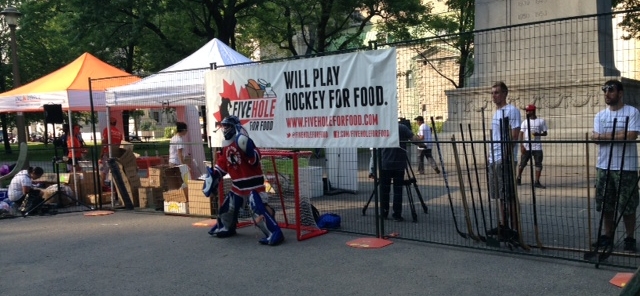
Five Hole for Food Toronto
I heard about Five Hole for Food when I was grabbing a lunch with a friend of mine. He said, "I hear there is a street hockey game downtown today. If you bring your hockey stick and a non-perishable you can play...."  I thought it sounded cool, so I grabbed 2 buddies and went.
Two hockey snipers wait for their shift

Branded sweaters and boards.

The idea behind Five Hole for Food is a simple (and very Canadian) one:  Raise food donations for the local food banks through an organized street hockey games across Canada. With the help of Telus, ING and other sponsors, Five Hole for Food organizers travel across Canada (St John's, Halifax, Charlottetown, Montreal, Ottawa, Toronto, Winnipeg, Regina, Calgary, Victoria and Vancouver), and set up and organize street hockey games in visible sections of each city. Local volunteer street hockey players show up with a hockey stick and a non-perishable food item. The non-perishable item is the "access pass" to play. The hockey stick is needed, of course, to participate in the the self-regulated game. The game has Five Hole for Food sweaters and "hockey boards" branded with "Five Hole for Food" and the local food bank signage. The game attracts a crowd given its novelty and location. After a day of drop-in game play, Five Hole for Food gets the players remaining to participate in a video, "We are --- city name ---. We will play hockey for food." Check out Montreal's shout out at the end of the video.


In its 4 years of operations, Five Hole for Food has collected hundreds of thousands of pounds of food. This comes at a time when many food banks complain that donations have been at 50 year lows (see articles: desperate for donations, running out of space, food, help).  But what impresses me is the foundation upon which this new brand non-profit organization can have impact and grow.

Five Hole for Food has partnered with local food banks in 9 cities across the country. From a branding perspective, this means that Five Hole for Food has leveraged credibility from the local banks and has established roots to form a national brand. If Five Hole for Food continues to execute well, it will likely be invited into other communities - enhancing its brand penetration and growth.

From a brand strategy point of view, Five Hole seems to have aligned each relevant party's interest. From the food bank perspective, donations are cyclical, swell around Christmas time and deplete in the summer. By organizing in  games and food donation drives in the summer, Five Hole for Food moderates this food depletion and heightens awareness to the year-round problem of hungry people. From a city point of view, what city would not want to donate a block of land to raise thousands of pounds of food for its disadvantaged cities? (Privately, organizers told me of some struggles that the organization had with city hall in two cities. Shameful.) And, from the participant point of view, it is a lot of fun in a making a difference.

In my workshops, I often drive at the point that there is no better way to create a strong brand than via direct experience. This is something that many charities (and even for profit) brands do not get.  My interactions with a lot of charities that I donate to is really an annual call, "can you donate some money?"  But get a group of people together who love doing the same thing- and doing it in the spirit of helping others... that's a feel good experience. Mix in hockey for a Canadian and there is a deeply patriotic emotional experience.
Cardboard media: relating food and poverty - suitable for social media share
As if reading my mind when we walked by the mountain of food at the end of the day, one player said to me, "Wow! That's a lot of food for a lot of people. And it was so much fun to play. I can hardly wait for next year. What about you?" I responded, "Next year, I will be back to play hockey for food."


Monday, October 8, 2012

Stories of Sight, Sound and Substance: Perspectives on Presidential Candidate Marketing

PREAMBLE:

Nothing is more raw in terms of branding and marketing than American presidential political campaigns. Candidates, and their respective parties, segment the voting market into fine-tuning micro segments, target the electorate based on tightly defined demographics, psychographics, and lifestyle, and brand themselves using every communications tool in the book. Things that would be illegal in the business world, like intentionally misleading facts or suppressing voters seem to be acceptable- if not expected- in the American presidential political world. With one month of campaigning remaining in this 2012 presidential election, presidential ad spending recently soared past $700 million, an amount that has already exceeded 2008's total. What makes this amount even more interesting is this: the percentage of American voters who are truly "up for grabs" is between 3-5% of voters (New York Times). So, if around 130,000,000 people vote in this year's election (2008 figures were 131,000,000), parties and their surrogates will be spending around $150 just on ads to target each swing voter, if you believe the New York Time's assertion. If that ain't marketing and branding at its rawest, I don't know what is.

I wish to underscore the notion that this blog, which is probably closer to an essay, focuses in on the marketing and branding side of presidential elections- not the politics of it. 

Stories of Sight, Sound and Substance: 
Perspectives on Presidential Candidate Marketing

Since TV, they say, sight matters most. 

On September 26th, 1960, Senator John F. Kennedy faced off (pun intended) against Vice President Richard M. Nixon in the first televised American presidential debate.  Those who heard the debate on radio thought Nixon was the victor. Those who saw the debate on TV, which was viewed by around 70 million Americans, thought Kennedy was the clear winner (1).  Another way of looking at it, in this first debate, Nixon had the substance and sound advantage.  Kennedy had the sight advantage. But at the end of the debate, the producer of the debate and founder of 60 Minutes Don Hewitt said , "When that [first] debate was over, I realized that we didn’t have to wait for an election day. We just elected a president. It all happened on television.(2)"  Here's how it happened.

Telegraph image: tanned Kennedy, producer Hewitt, and pale Nixon
The handsome Kennedy was a lot younger than Nixon.  Kennedy (and his handlers) understood the importance of the new television technology as an image building vehicle and communications tool. Kennedy prepped, rested up, and wore make-up. Nixon, on the other hand, didn't prep as much and  refused to wear makeup. The contrast on TV was stark. Kennedy "looked tan and fit...... a matinee idol,” while Nixon looked " like death warmed over" (Don Hewitt). Nixon looked pale, sweaty, and unhealthy. His grey suit probably didn’t help on the black and white television screens either. To Nixon’s defense, he had been in a pretty bad car accident before the debate- and the accident was severe enough to have him suspend campaigning for 2 weeks. To Kennedy's luck, he had been campaigning in California and captured more of a tan.  But TV cameras don’t tell that story. The “vision” of the television tube did what it is supposed to do- communicate with visual motions. In the end, Kennedy’s brand image was built by sight while Nixon’s was being destroyed by it. Visuals mattered more than what was being said, or how it was being said. Substance was beaten by sight.

This leads to the question- how much more does sight matter in image building than sound and substance in a presidential debate? Let's check out some evidence.


President Reagan, master of the 85-10-5 rule.
Mike Deaver was the management chief of President Reagan's image in the media. Deaver, who himself was involved in prepping Reagan for his presidential debate formulated a 85-10-5 heuristic. More specifically, a visual event -ie television or public event - is  85 percent sight (how you look), 10 percent sound (how you sound) and 5 percent substance (what you actually say) (3).The Gipper, probably better than any other president in modern history, had a natural advantage with the visual part, given his training as a Hollywood actor. Through non-verbals, Reagan could convey emotions and subtleties through his facial expressions and body language. He’d have the perfect mannerisms when he was expressing sympathy (e.g. when the Challenger blew up), comedy (e.g. “I will not make age an issue in this election"), or challenges (e.g. “Mr. Gorbachev, tear down this wall” speech). He was the visual master. His media team knew he could feign a tear or light up a room with his eyes.

Here’s another take on how much more powerful sight is over sound and substance. There's a story on Reagan that has circulated among many political marketers.  It was also reported in Brian Stewart's CBC documentary the Reagan Years. This story tells of a left-leaning reporter who wanted to dint conservative Reagan's popularity by doing an “exposé” on network prime-time. The reporter aired video footage of Ronald Reagan smiling broadly with a shovel breaking ground for a new school in a low income district with school-board members applauding. Then a voice-over provided a punch that Reagan's education cutbacks were  leading to problems in education. She’d show footage of Ronald Reagan , surrounded by smiling seniors, cutting a giant big ribbon with event-sized scissors for a new senior’s home while the voice-over would harshly criticize Reagan's senior citizen subsidization slash. She’d have video clips of an affable Reagan in jeans planting a tree with some tree planters while her voice-over would blast his environmental record. On and on the exposé went. And, immediately following the program, the reporter’s phone rang. It was the White House Press Secretary. And the reporter was prepared for her fate – never to be invited back to the White House for press conferences again.  According to the story (and Stewart's documentary) the transcript of the conversation went something like this:


Reporter: Did you see my 15 minute news segment tonight?
WHPS: Yeah. Thanks. It was terrific!
Reporter: What are you talking about???  Didn’t you hear what I said?
WHPS:  You don't get it. When the visuals are that good, nobody hears what you say!

Recent academic research also supports this notion that visuals matter more than what you say. Research exploring how much do appearances of politicians influence voters  was done by University of California Berkley political science professor Professor Lenz. His study with Chappell Lawson, Andy Baker, and Michael Myers went like this: Voters in the USA and India were shown real election matchup photos (think campaign sign images) from Brazilian and Mexican candidates. When asked which candidate would make a better elected official, the study participants, regardless of where they lived, tended to select the same candidates. More importantly, their selections were actually aligned with the outcomes of the Brazilian and Mexican elections. Keep in mind, this study only dealt with the images of the candidates. There was no sound, no substance.  Yet, our conclusion is consistent. Appearances of politicians heavily influence voters. In short. Visuals matter most.


The information that I've presented above is "old news" to the image makers of politicians (and journalists-with-an-agenda) who understand the disproportionate influence that visuals have. Their responses have been obvious: Feed the content broadcasters (and narrowcasters) a pipeline of images.  Sometimes the images are more subtle, sometimes more overt. Here's a simple test, involving 3 images. What are these images communicating about President Obama? 


You can almost hear the angels sing when looking at President Obama's pictures.

What's this this picture of Republican Vice Presidential candidate Paul Ryan from the guardian trying to convey?


You can almost hear the goosesteps from the SS when looking at it.
 
If you are a Democrat marketer, these sorts of images go a long way to tell their story that President Obama is "saving the country from a Bush mess" or "Paul Ryan is scary". By the way, the halo-esque Obama images have been published on the bulk of major content publishers- from Reuters to AP to the cover of Newsweek and even on Fox. I don't think you need the poli-sci  researchers to drive to the conclusion that, if voters are being blasted with contrasting images like this, that the winner can be predicted. Headlines and substance are trumped by sight.

We're now in a different era than when the first televised debate took place. Let's look at a some of the key phenomena that shape presidential campaign marketing in 2012.

Phenomenon 1- More complex  issues and escalating amounts of information.
The outcome-  More voter reliance on visuals to make decisions.

The world is a lot more complex than it used to be politically and economically. Topics debated at the presidential level include cutting $5 trillion from the budget, Simpson-Bowles, quantitative easing, and financial regulation legislation. Some of these proposed  laws (and laws)  are incredibly complicated, as evidenced by the  2700 pages written to regulate healthcare ("Obamacare").  On top of that, there are a lot more laws to absorb and evaluate. One stump speech by Ron Paul made the claim that  40,000 new laws were "put on the books" on the first day of 2012 in the USA. (Some independent fact checkers say this number has some exaggeration to it but numbers are likely to be close to 30,000). It would take a considerable amount time and effort for an average voter who has a family, a job (or jobs) and social responsibilities to get to the heart of  many of these issues, let alone spend time reflecting on the interplay among them. Beyond the complexity, other day-to-day information is bombarding the average consumer at an unprecedented rate. In  a  study published in the American Academy of Pediatrics in 2006, more than 10 years ago, the average consumer was targeted with up to 3000 ad communications a day. This number is undoubtabely much much higher in 2012, as marketers have more tools to reach consumers (e.g. via mobile devices and social networks).  

So if the average American doesn't have time (in many cases ability) to sift through complicated jargon and issues and needs to make decisions on voting, trusted heuristics are needed. For many voters, then, the issue becomes which candidate is more likeable and trustworthy?  Since "trust", "likeability", and other "favorability" characteristics are  easily picked up visually (and humans are good at picking up visual communications quickly),  the candidate's sight cues like facial expressions, gestures, posture and dress become that much more important in campaign marketing. This is why leading pollsters like Gallup and Rassmussen Reports poll trust and likeability. They are shortcut voting proxies. Presidential candidate image makers are acutely aware of this as well. That's why during the debates, the politicos negotiate everything from the size of the podiums (so as not to make a tall candidate look awkward, or a shorter one look weak in stature) to background color of the screen. In a time constrained complex environment, visuals matter even more.

Phenomenon 2- Greater demand for news content.
The impact- More managing the downside for the candidate and less voter trust in media news.

Generally speaking, news used to be part of an old boys oligopoly.  For over 30 years (beginning in 1948), 3 major national television sources (ABC, CBS, and NBC) and a handful of widely distributed regional /topical newspapers (e.g. Wall Street Journal, New York Times) framed the bulk of national news for Americans. This began to change in the 1980s, when Ted Turner launched CNN (the first 24 hour news network) and USA Today  hit the streets as America's first national daily. But in 2012, scores more news channels, cable news networks, online news sources, independent news reporters, and news data collection agencies have been established. This means the demand for finding news - faster - is greater than ever before. What sort of news sells best? Bad news (See synthesis paper on the negativity bias Bad is stronger than good). So there is an increasing effort to find the bad news. Meanwhile, with content gaps, especially on "slow news days", 24 hour news programs still need to fill their lineup. So what do news-starved news organizations do?

The first is repeat content. Watch any cable news show. "Headline news stories" can be repeated many many times an hour. From a political point of view political gaffes are a favorite. For example, according to the folks at You Are Being Manipulated, the "Dean Scream" (which had Democratic presidential primary candidate Howard Dean looking and sounding like a donkey), was replayed over 600 times on the major networks over 4 days.  
President Bush's Top 10 Gaffes according to Letterman
I'll argue that a fundamental reason why President Obama has held the least number of Q&A's with the press / press conferences of modern presidents (Martha Kumar from Towson University tracks this data) and relies heavily on his teleprompter is  because he doesn't want to leave anything to chance. He wants to avoid the Dean Scream / President George W. Bush gaffes / Vice President Joe Biden / Sarah Palin gaffes that end up being replayed over and over on the news, became fodder for comedians, and gaffe viral hits  on social media. And as for President Obama's dismal performance during the first presidential debate of 2012, that's partly explained by his price for teleprompter addiction.

A second means to fill in news content is to bring in more talking heads and spin doctors. These folks are more likely play loosey-goosey with the facts (a politician at least has to face voters as an accountability check, spin doctors don't). Just think of the interview with former Vice President Al Gore who claimed that Obama's weak performance in the first debate was due to the high altitude in Denver. (Even more astonishing is that none of the talking heads challenged him!) With news being reported like this, we can see why why 6 in 10 Americans in 2012 have "little or no trust"  in mass media to deliver the news "fully, accurately and fairly."


The phenomenon- Voters search for reliable news sources.
The impact- Polarized electorate, The search for the Big Mo.

So where do folks go to find news they trust? Many voters seek out news that reinforces their pre-existing political notions.Conservative, gravitate to Fox News, Rush Limbaugh, or Drudge Report.  Liberals prefer MSNBC, Mother Jones, or the New York Times. 

Another area to get "trusted" information is from friends.  Friends tend to share similar socio-economic-educational characteristics, meaning that political views will tend to be more similar too. But let's say a socially-connected voter has a group of friends who post diverse political viewpoints (libertarian, conservative, liberal, communist etc) on social networks. If our voter were to click on the libertarian links more often, a social network algorithm would kick in and the progressive links would no longer be displayed. This is the case made by Eli Pariser during a Ted Talk. He also goes on to argue that Google searches on political information can be screened to based on previous searches. The upshot of this would be that if voting groups are not seeing proper representation of the other side's point of view, then  a common fact-base, necessary for a good debate may be in jeopardy. This hardens partisan line resulting in two outcomes. First, less fluctuation in the voting blocks. Second, marketers need to make momentum stories to attract the shrinking number of swing voters.


Obama's sweet Tweet: "This seat is taken"
The search for momentum (the Big Mo), often comes in the form of "whats trending" or "sentiment analysis."  This takes the form of sexy topics - sentiment analysis on Twitter, YouTube views, or Facebook likes. So the political presidential campaign goes to war here. It seems that the Obama marketers have understood this a lot more- having massed over 20,000,000 Twitter followers for the President.  That sounds pretty impressive.  20,000,000 disciples to Tweet powerful images like "This seat is taken" in response to Clint Eastwood's Republican National Convention speech. Of course, marketers can get caught in their own "trending" spin. According to Yahoo News (and USA Today), 13,000,000 of President Obama's 20,000,000 followers are fake (false accounts/not purchased).

Eastwood at the RNC and the New Yorker cover (Oct): The empty chair belongs to 13 million of Obama Twitter followers

The upcoming phenomenon:  Mercenary news
A final phenomenon that I believe has started- and I predict will grow tremendously is something that I call mercenary news. As more and more people have smart phones with recording device, and more footage is collected in private moments, footage will find its way going to the highest bidder. We caught a glimpse of this from Romney's infamous 47% moment. Of course, what Romney said was at best politically stupid, at worst- offensive, and it was not in a private moment. But he was captured on film by a hidden camera.  President Jimmy Carter's grandson, did some hard core sleuthing, found the video and accessed it with a lot of persuasion and an undisclosed sum.  Look for more of this type of news collection in the future. Especially when close to $1billion dollars is allocated to presidential ad spending.